
Practice
Traditional
Astanga Yoga
A personal, progressive practice where breath, movement and attention come together.
Explore the practiceIntroduction to Astanga Yoga
Breathe. Focus. Move.
Astanga Yoga is a dynamic practice in which movement and breath are closely connected. A progressive sequence of postures gives the practice structure, while breath and attention give it depth.
At Astanga Yoga Studio Copenhagen, we primarily teach through the traditional Mysore method. Rather than everyone following the teacher through the same class, each student gradually learns a personal practice and moves through it independently, with individual guidance from the teacher.
At first, you are learning what to do. With repetition, the sequence becomes familiar and your attention can move toward how you are doing it: your breath, movement, stability, effort, concentration and the changing experience of your body and mind.
This is one of the qualities that can make Astanga a lifelong practice. The external structure remains relatively stable, while your understanding of it, and of yourself, continues to develop.
The physical practice, however, is not the final purpose of yoga. Within the yogic tradition, practice ultimately points towards direct experience of consciousness itself, beyond the usual fluctuations and identifications of the mind. The postures, breath, vinyasa, drishti, bandha and repetition give us a practical framework for turning attention inward. Yoga then becomes more than something we understand intellectually. It becomes something we can begin to experience within ourselves.
Astanga Yoga can be adapted to different ages, bodies and levels of experience. You do not need previous yoga experience to begin, only curiosity and a willingness to learn.
The Mysore method
The practice becomes familiar.
Your attention becomes more refined.
Astanga is built around repetition. We return to a familiar sequence, not because there is nothing new to learn, but because familiarity creates the conditions for deeper learning.
At first, much of your attention goes into remembering the sequence. Gradually, you no longer need someone to tell you every movement. Attention can move towards the breath, the quality of movement, stability, effort, concentration and the subtle differences you experience from one day to another.
This is one of the central ideas of Mysore practice. The teacher guides you, but gradually you learn to carry more of the practice yourself.
This attention develops through the physical practice itself. As the sequence becomes familiar, less attention is needed simply to remember what comes next. That gives us more space to notice breath, sensation, thought, reaction and the quality of awareness itself. In this sense, Astanga is an awareness practice as much as a movement practice. The sequence is the structure through which we learn to pay attention.
You are not simply attending yoga classes. You are learning how to practise.
Practice
Explore the practice
Discover the method, philosophy and practical elements that make Astanga Yoga a lifelong practice.
01 How is Astanga taught: Mysore and Led Class
Astanga Yoga as a sequence of postures linked with the breath was shaped by the yoga and Sanskrit scholar Sri Tirumalai Krishnamacharya (1888–1989). Among his students was Sri K. Pattabhi Jois (1915–2009), who studied with Krishnamacharya from 1927 and went on to develop the Astanga Yoga series largely as they are practised today.
In Mysore, Pattabhi Jois taught his first foreign students individually, a few postures at a time. Many began with little more than the sun salutations. As a student came to know a posture and could remember the sequence so far, another posture was added, gradually building toward the full Primary Series and, later, Intermediate Series. This gradual, individual way of teaching became known as Mysore-style practice, and it remains our primary way of teaching today.
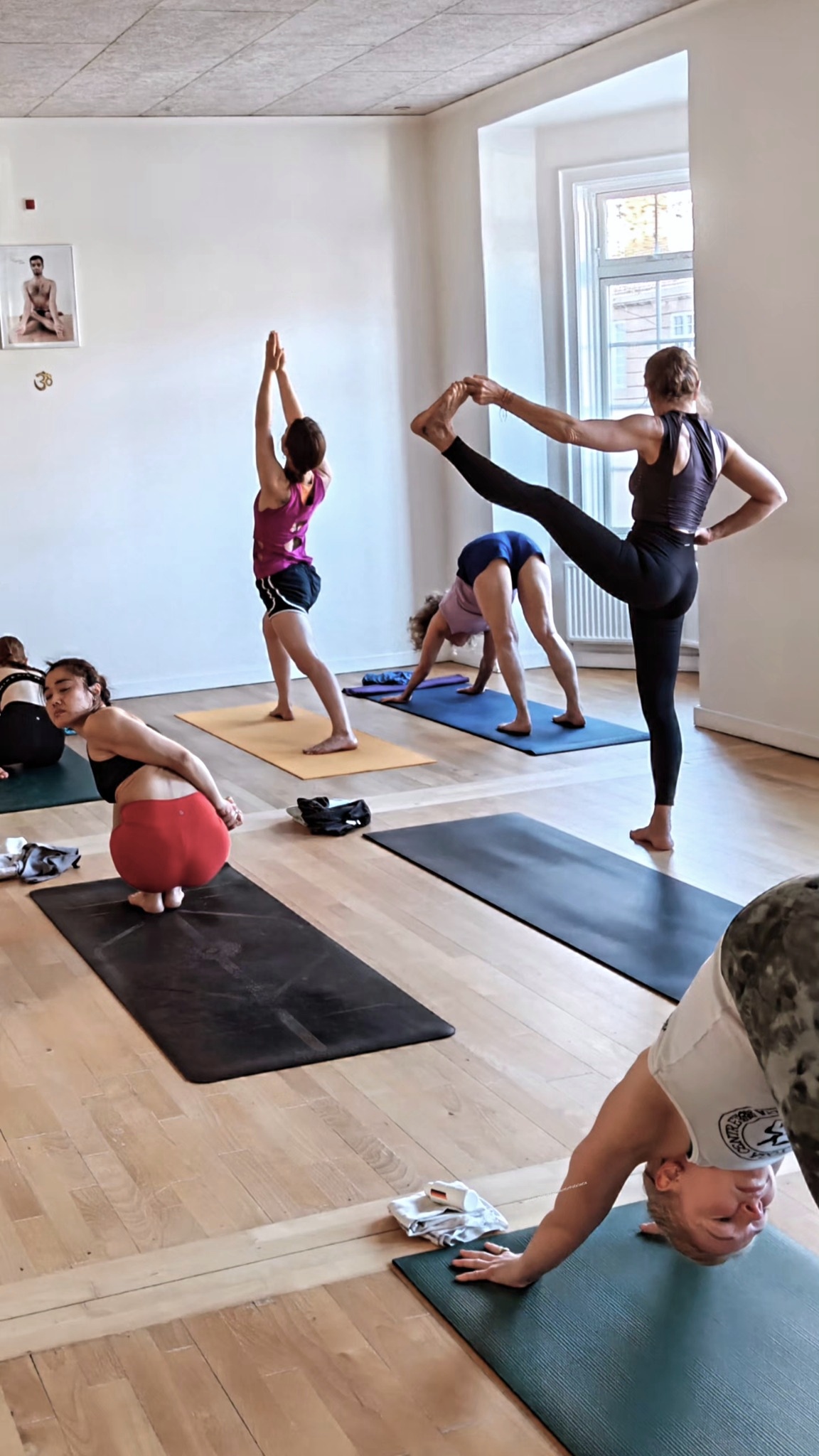
In a Mysore class, everyone practises in the same room, but each person works with the part of the sequence they have learned, at their own pace. Because most students already know what they are doing, the teacher does not need to lead the whole room at once, and can instead move between students, helping where it is useful. There is no single starting time, only a window within which to arrive and complete your practice.
New students receive more guidance: help remembering the sequence, adjusting the breath, and modifying postures where needed. As the sequence becomes familiar, that guidance naturally lightens. Learning the sequence gradually transfers responsibility from teacher to practitioner, and once you no longer need to be told what comes next, your attention is free to move toward breath, movement and awareness. You return to a familiar practice not because there is nothing new to learn, but because familiarity allows you to notice more.
Astanga is also taught through Led Class, which follows the traditional Sanskrit vinyasa count. Everyone moves through the sequence together, breath by breath, at a pace set by the teacher. Led Class establishes and reinforces the rhythm between breath and movement, and lets you feel the shared rhythm of practising the series together. It complements Mysore practice rather than replacing it, most students continue to learn and develop their personal practice primarily through Mysore classes.
Led Class has its own history within the tradition: the first led classes were given by Pattabhi Jois during a visit to the United States, where growing numbers of students made a shared, counted class practical for a large group.
All classes are taught by Eskil Schilling, who is a Level 2 authorised Astanga Yoga teacher through SYC , the Sharath Yoga Centre in Mysore, India (formerly KPJAYI).
We offer morning and afternoon Mysore classes from Monday to Friday, and Led Class on Saturdays. For more details, see the Schedule . There is no Mysore class on Sundays and on full and new moon days. You can find out when is the next full/new moon day from our Moon Days page.
We recommend practising up to six days a week, moon days aside, but it is fine to begin with just a couple of sessions a week and build up your own rhythm, you can come at the same time each day, or vary it according to your schedule.
We also offer a weekly class on chanting, technique or philosophy (the subject varies), included in the monthly membership.
02 New to Astanga Yoga?
You do not need any previous experience with yoga or Astanga to begin.
In Mysore, beginners are taught individually and gradually. Your first practice may consist of only a short sequence that takes around 20–30 minutes. As you become familiar with the breath, movements and sequence, the practice develops step by step.
This makes Mysore particularly suitable for beginners. You do not have to keep up with an experienced class or already know the sequence, you learn it directly from the teacher, at a pace appropriate for you.
Regularity is more important than how much you can do. Practising consistently allows the sequence to become familiar, and gives the teacher the opportunity to understand how best to guide you.
Visit our Getting started page to learn more about how to begin.
03 What is Mysore style?
Mysore is a way of learning yoga through personal practice.
Everyone practises together in the same room, but each person works with the part of the Astanga sequence they have learned, at their own pace and with individual guidance from the teacher.
At first, this can seem unusual if you are used to guided classes, nobody is standing at the front continually telling the whole room what to do. That is intentional.
As you memorise the practice, responsibility gradually shifts from the teacher to you. Instead of continually listening for the next instruction, you begin to listen more closely to your breath, your movement and your own experience.
The sequence becomes familiar, but the practice does not become static. Familiarity creates the opportunity to notice more. Over time, the same practice can reveal increasingly subtle aspects of movement, effort, concentration, breathing and awareness.
The teacher remains present, observing and helping when useful, but the aim is not to make you dependent on constant instruction. The aim is to help you develop a practice that becomes increasingly your own.
The practice becomes familiar. Your attention becomes more refined.
If you are new to Astanga Yoga, visit here to learn more about how to start. You can read more about the learning steps here.
04 What Mysore develops
These qualities develop together, each supporting the others.
- A personal practice adapted to you as an individual
- Independence and responsibility for your own practice
- A deeper relationship with your breath
- Concentration and sustained attention
- Learning through repetition rather than constant novelty
- The ability to notice subtle changes in body and mind
- Individual progression, without needing to follow the pace of a group
- A direct, ongoing relationship with your teacher
- The ability to practise independently, including outside the studio
- A practice that can continue to develop over many years
05 Mysore and guided classes
Guided classes and Mysore practice offer different ways of learning.
In a guided class, the teacher carries much of the structure. Everyone generally follows the same sequence and pace, which makes the format immediately accessible and creates a strong shared experience.
In Mysore, the teacher gradually transfers more of that responsibility to the practitioner. You learn the sequence, work at your own pace, and receive individual guidance when it is useful.
Neither format is inherently better in every situation, they simply cultivate different skills. Guided classes can be an excellent introduction, and can create energy, rhythm and a shared experience. Mysore places particular emphasis on independence, repetition, sustained attention and the development of a personal practice over time.
A guided class can give you an experience. Mysore gradually teaches you how to practise.
06 What the practice develops
The physical practice trains attention as much as the body. Both dimensions are reflected below.
- Strength
- Mobility and flexibility
- Coordination
- Balance
- Breathing awareness
- Concentration
- Body awareness
- Consistency
- The ability to regulate effort
- Familiarity with your own patterns and responses
07 What are the different series?
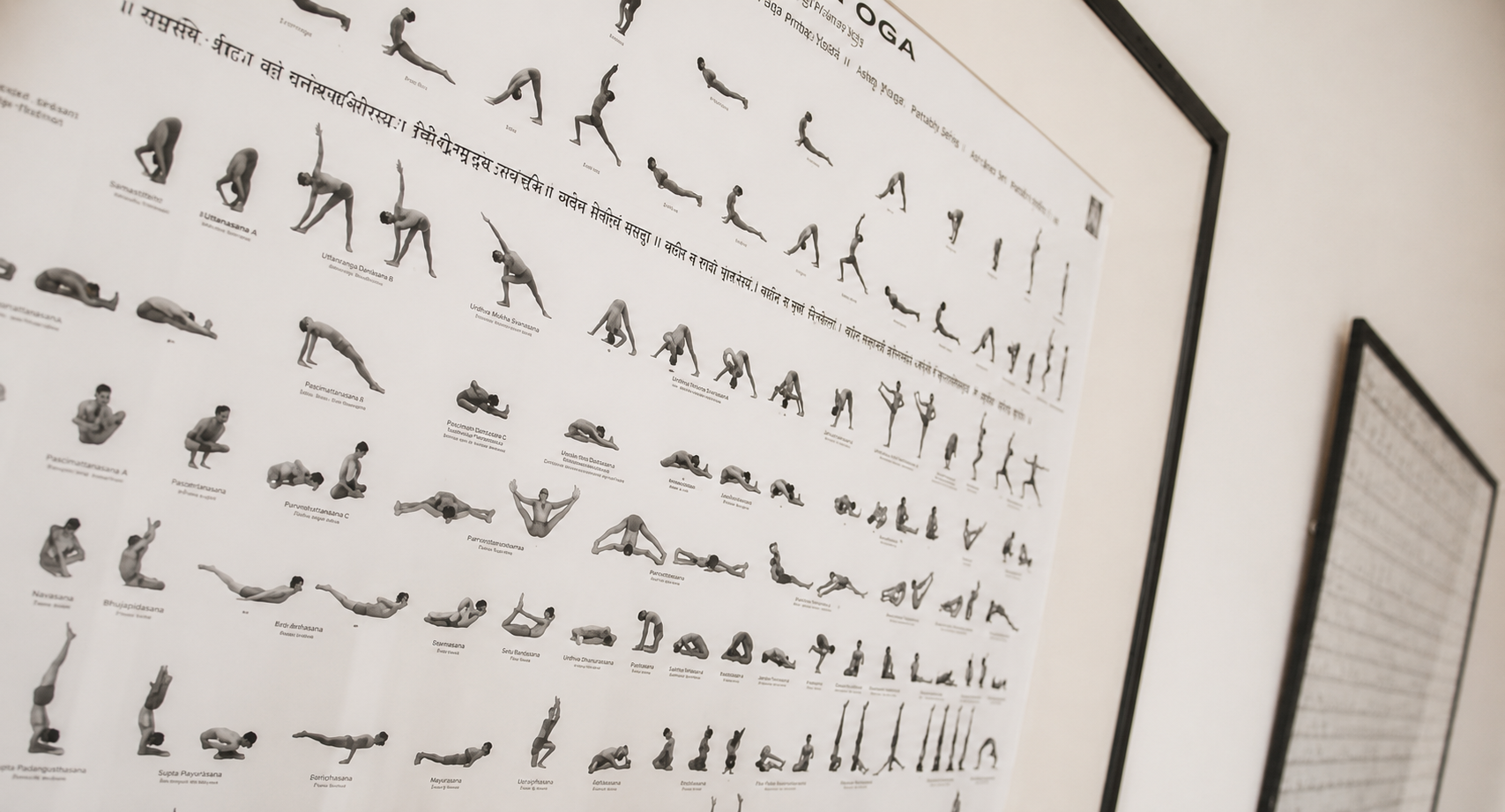
Primary Series
Primary Series is traditionally called Yoga Chikitsa, often translated as "yoga therapy". It works through a fairly complete range of movement, forward bends, twists, hip-opening postures and gentle backbends, and forms the foundation of the whole system. A full practice takes around an hour to ninety minutes, beginning with the sun salutations (Surya Namaskara A and B) and moving through standing postures, seated postures, a few inversions and backbends, before finishing. It is traditionally practised in the morning, on an empty stomach.
Intermediate Series
Intermediate Series is traditionally called Nadi Shodhana, often translated as "purification of the nervous system" or of the subtle energy channels. It follows a similar structure to Primary Series but introduces deeper backbends, hip-opening postures and more demanding balances. Moving into Intermediate Series is based on a stable foundation in Primary Series rather than a fixed point in time, your teacher will guide you on when it makes sense to begin.
Advanced Series
The four Advanced Series are traditionally called Sthira Bhaga, often translated as "divine stability". Pattabhi Jois originally outlined two advanced series, later dividing them into four to make the material more accessible. They emphasise demanding arm balances and are appropriate for experienced practitioners with an established Intermediate Series practice.
Progression through the series is based on stability, understanding and your teacher's guidance, not a fixed timeline. Depth is also progression: breathing more steadily, moving with greater efficiency, or understanding a familiar posture more deeply are all part of how the practice continues to develop.
08 What is Vinyasa?
In traditional Astanga Yoga, Vinyasa refers more broadly to the coordinated relationship between breath and movement, and to the specific, prescribed movements that connect one posture to the next within the sequence. Each movement is linked to a single inhale or exhale, so that breath and movement happen together rather than one following the other.
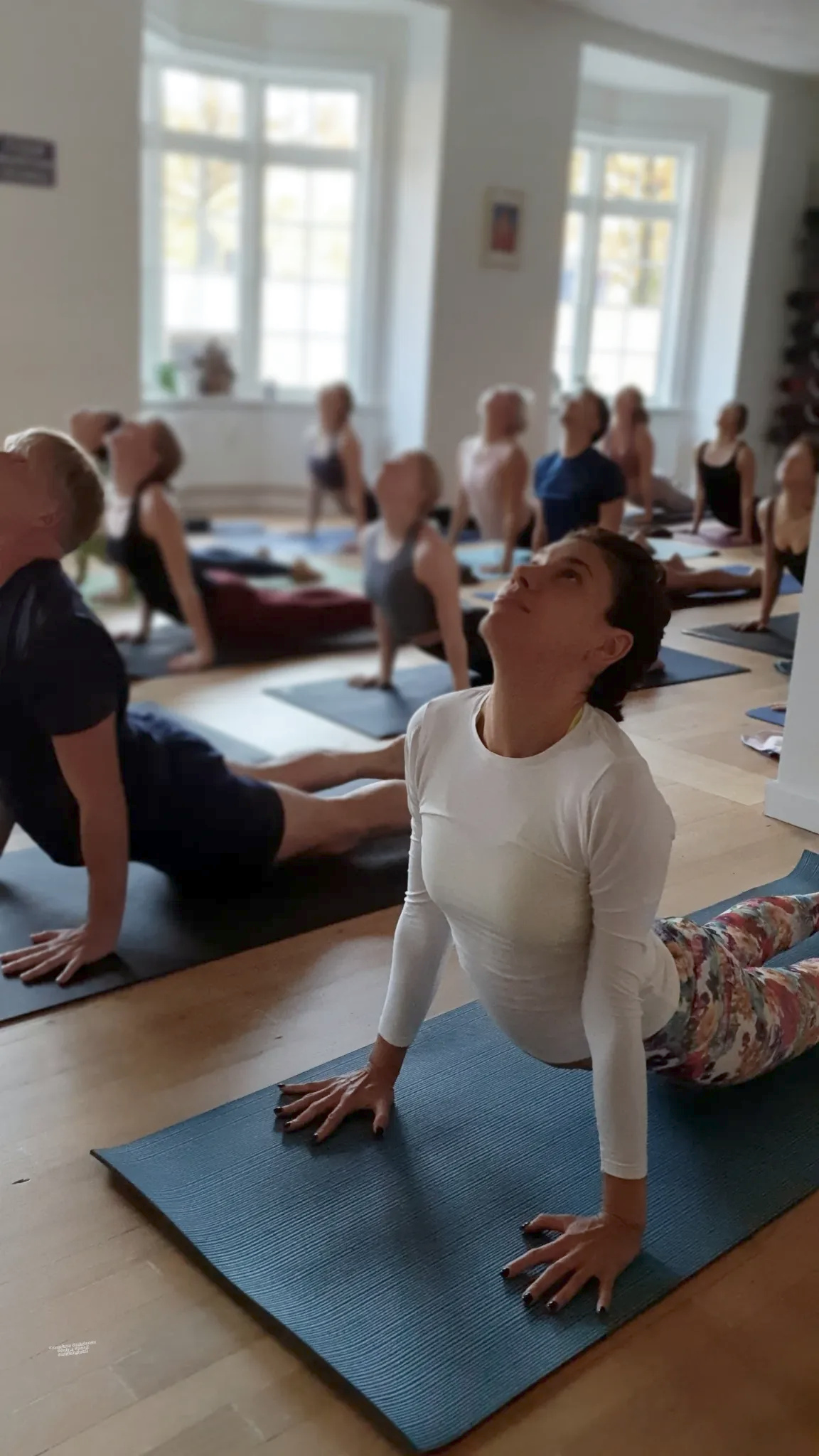
Because these transitions repeat throughout the practice, often including the movement from Chaturanga Dandasana through Upward-Facing Dog to Downward-Facing Dog, they become familiar. That familiarity is part of the point: as the movement pattern becomes known, attention can increasingly stay with the breath rather than constantly anticipating what comes next.
Vinyasa also gives the practice its rhythm and continuity, linking individual postures into one connected sequence, and helps build heat, strength and stamina along the way.
09 What is Tristhana - the three places of attention?
Tristhana refers to three places of attention that are brought together throughout an Astanga practice: asana (posture), breath (traditionally linked to pranayama), and drishti (gazing point).
Astanga is not simply a physical sequence performed correctly. The repeated structure of the sequence gives the practitioner a stable framework within which posture, breath and gaze can repeatedly be brought together, practice after practice. This is one of the ways the physical practice develops concentration: not as a separate exercise, but as something trained through the practice itself.
Working with all three elements at once is part of what makes Astanga both a physical and a contemplative practice.
10 Breath
Breath is one of the most important elements of Astanga practice.
The aim is to maintain a steady, conscious breath, with a similar length of inhale and exhale, even as the physical demand of the practice changes. Breath gives the practice its rhythm and becomes a continuous point of attention throughout.
This is not always easy, and a genuine, consistent effort is enough, it also helps settle the nervous system. Over time, you learn not simply to complete postures, but to notice when effort is disturbing the quality of your breath. This is one of the ways the practice teaches regulation, attention and appropriate effort.
11 What is Drishti?
Drishti is the point where your gaze rests during practice. Rather than the eyes following everything happening around the room, the gaze has a defined direction for each posture.
This helps stabilise attention and balance, and contributes to the quiet, concentrated quality of a Mysore room, something especially relevant when many people are practising alongside each other in the same space.
There are nine traditional drishtis, specific points on the body or in the environment that the practitioner is encouraged to direct their gaze toward:
- Nasagrai (tip of the nose)
- Urdhva or antara(upward)
- Hastagrai (hand)
- Parshva (side)
- Angustha Ma Dyai (thumb)
- Bhrumadhya (middle of the eyebrows)
- Padhayoragrai (feet, big toe)
- Nabi (navel)
- Agya (third eye)
12 What is Bandha?
Bandha refers to the internal engagement traditionally used throughout Astanga practice to support stability, breath and attention. There are three principal bandhas: Mula Bandha (root lock), Uddiyana Bandha (abdominal lock) and Jalandhara Bandha (chin lock).
Mula Bandha engages the pelvic floor, providing a sense of grounding and support through the lower body.
Uddiyana Bandha is engaged on the exhale, drawing the lower abdomen gently in and up, supporting the core and the breath.
Jalandhara Bandha involves a slight drawing of the chin toward the chest, used most often during particular breathing practices.
Together, the bandhas are part of the internal technique of Astanga: used throughout most postures, they support stability and help direct attention inward, working alongside the breath rather than as a separate effort.
- Mulabandha - root lock
- Uddiyana - upward flying lock
- Jalandhara - chin lock
13 Teacher Training and Parampara
In the Astanga Yoga tradition, there is no formal teacher training in the same way as in many other styles of yoga. Instead, the path towards teaching is built on many years of personal practice, continued study, and close guidance from experienced teachers, traditionally including regular periods of study at the institute in Mysore, India.
At the core of the tradition is parampara , a Sanskrit term for the direct transmission of knowledge from teacher to student. A student will typically practice and study with their teacher for many years, and when the teacher considers them to have the necessary experience and understanding, they may be invited to gradually begin teaching. In this way, the ability to teach develops through direct experience of the method and a long-term relationship between teacher and student.
Teacher trainings and shorter certification programmes have become common in modern yoga, but they are not part of the traditional path to becoming an Astanga Yoga teacher. Authorisation and certification within this tradition are given by the institute in Mysore. To be considered for authorization, students are expected to have completed several extended periods of study in Mysore and to have established a stable, long-term personal practice.
In addition to studying in Mysore, many students who wish to develop as teachers choose to apprentice with an authorized or certified teacher. This provides an opportunity to observe and participate in the teaching process over an extended period and to gradually gain experience with the practice, individual adaptations, and the teaching method itself.
An apprenticeship is therefore not a short teacher training course, but a long-term process that will typically extend over several years. It is based on continuity, personal practice, practical experience, and close guidance.
If you would like to deepen your study of Astanga Yoga and potentially develop as a teacher, an apprenticeship with us is one way to do so. We are very interested in working with students who want to follow this path and make a long-term commitment to both their own practice and learning how to teach the method. An apprenticeship develops over time and is adapted to each student's experience, practice, and ambitions. Please get in touch if you are interested or would like to know more.
To learn more about parampara and studying in Mysore, visit Sharath Yoga Centre .
14 Yoga Videos
Sun Salutation A
Finishing poses
15 Astanga Yoga Mantra
Astanga Yoga Mantra
Ashtanga Yoga Opening Mantra
ॐ
वन्दे गुरूणां चरणारविन्दे सन्दर्शितस्वात्मसुखावबोधे ।
निःश्रेयसे जाङ्गलिकायमाने संसारहालाहलमोहशान्त्यै ॥
आबाहुपुरुषाकारं शङ्खचक्रासिधारिणम् ।
सहस्रशिरसं श्वेतं प्रणमामि पतञ्जलिम् ॥
Oṃ
vande gurūnāṃ caraṇāravinde sandarśita-svātma-sukhāvabodhe |
niḥśreyase jāṅgalikāyamāne saṃsāra-hālāhala-moha-śāntyai |
ābāhu-puruṣākāraṃ śaṅkha-cakrāsi-dhāriṇam |
sahasra-śirasaṃ śvetaṃ praṇamāmi patañjalim ||
I acknowledge the teachers who help reveal the deep happiness already within,
and who guide us toward freedom and clarity
by calming the confusion of the mind that keeps us entangled in habitual patterns.
I honor the spirit of
Patañjali
, embodying strength, clarity, and expansive awareness ,
as a symbol of the integration of wisdom and action.
Listen here to Dr. M.A. Jayashree, one of the most respected Sanskrit scholars from Mysore, chanting the Ashtanga Yoga Opening Mantra.
Ashtanga Yoga Closing Mantra
ॐ
स्वस्ति प्रजाभ्यः परिपालयन्तां न्यायेन मार्गेण महीं महीशाः ।
गोब्राह्मणेभ्यः शुभमस्तु नित्यं लोकाः समस्ताः सुखिनो भवन्तु ॥
ॐ शान्तिः शान्तिः शान्तिः ।
Oṃ
svasti prajābhyaḥ paripālayantāṃ nyāyena mārgeṇa mahīṃ mahīśāḥ |
go-brāhmanebhyaḥ śubham astu nityaṃ lokāḥ samastāḥ sukhino bhavantu ||
Oṃ śāntiḥ śāntiḥ śāntiḥ |
May those who guide society protect the well-being of all people,
and may they lead with justice and integrity.
May there be harmony and prosperity for all living beings,
and may all beings, everywhere, live in happiness.
Oṃ Peace, Peace, Peace.
Curious to begin?
You do not need previous yoga experience. Learn gradually in Mysore classes with personal guidance.